
Misophonia Treatment in Vancouver & British Columbia
If specific sounds, chewing, breathing, tapping, sniffing, a pen clicking, provoke a reaction in you that feels disproportionate, involuntary, and impossible to explain to the people around you, you may be dealing with misophonia. It is not fussiness, and it is not something you can talk yourself out of. It is also, increasingly, something we know how to treat.
I'm Dr. Fjola Helgadottir, a registered psychologist practising in North Vancouver and downtown Vancouver, with online sessions available across British Columbia. I have lived with misophonia myself, and I have practiced for the past 20 years, studied and worked at Universities around the world, including at the University of Oxford where some of the most significant recent work on misophonia-specific CBT has been developed.
What is misophonia?
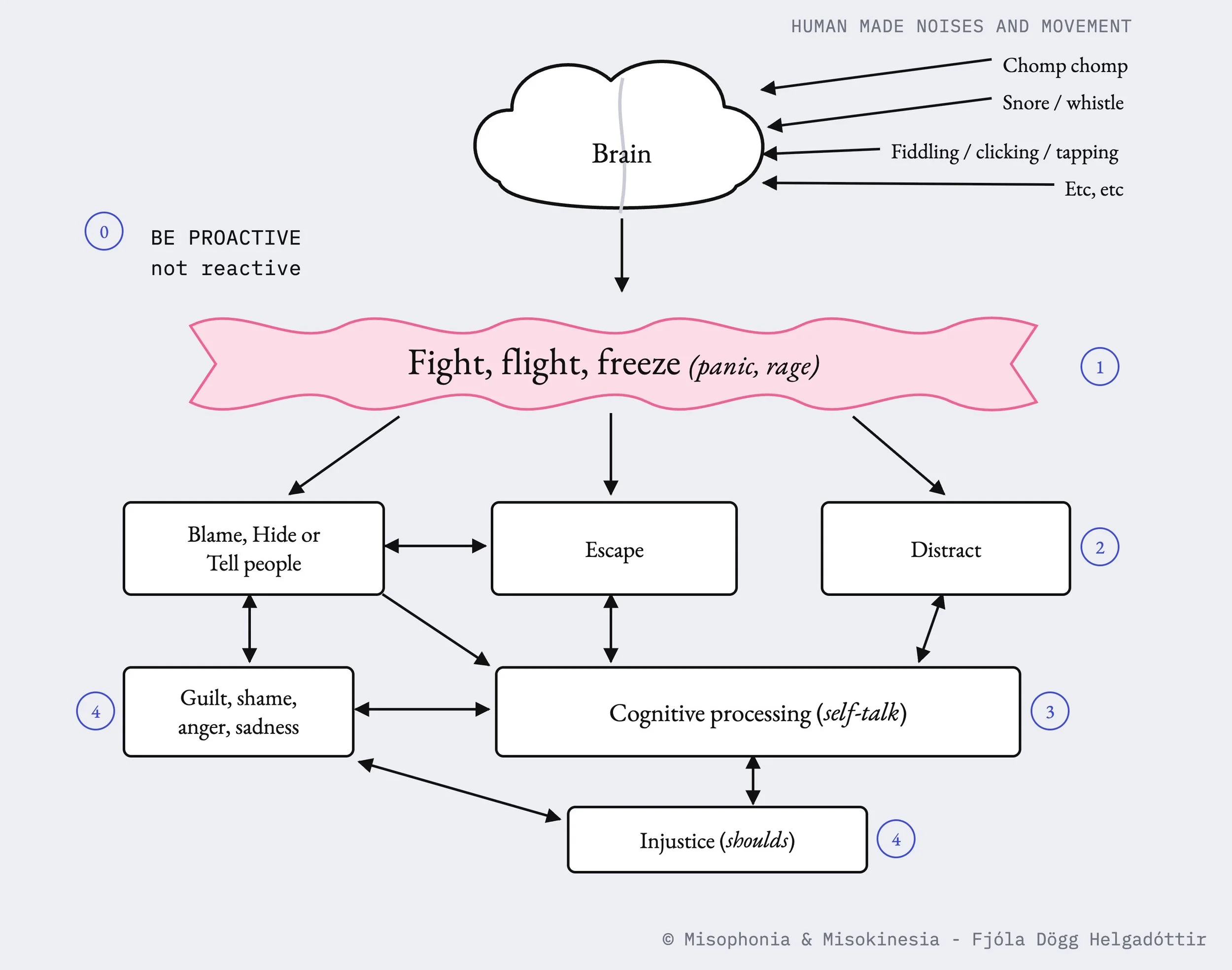
Misophonia involves intense emotional and physiological responses, commonly anger, disgust, panic, or a strong urge to escape. This is triggered by particular sounds, often ones other people barely register. Trigger sounds are frequently made by other humans, and reactions are often strongest when the source is a family member. Many people also experience visual triggers: seeing the movement associated with a sound can be enough to trigger a reaction. Some people also experience misokinesia (I do!), in which particular movements themselves are the trigger.
How common are misophonia and misokinesia?
You may be surprised to learn that sensitivity to particular sounds and movements is relatively common. However, there is an important distinction between experiencing some degree of sensitivity and having clinically significant misophonia or misokinesia.
A recent population-based study in Germany found that 33.3% of people reported sensitivity to at least one misophonic sound. Importantly, this does not mean that one-third of people have severe misophonia. When researchers looked at symptom severity, most people had subthreshold or mild symptoms, while a much smaller proportion experienced moderate-to-severe or severe symptoms.
Misokinesia refers to a strong negative reaction to seeing particular movements, such as someone shaking their leg, tapping their fingers, or fidgeting. In a large 2021 study involving more than 4,100 participants, approximately one in three people reported some degree of sensitivity to seeing other people fidget or make repetitive movements.
Misophonia and misokinesia can also occur together. For some people, both the sound and the sight of a particular behaviour can be triggering. For example, someone may react strongly to the sound of chewing as well as to watching another person chew.
These findings suggest that sound and movement sensitivity exist on a spectrum. Having an occasional strong reaction to a particular sound or movement does not necessarily mean that you have a disorder. What matters clinically is the intensity of the reaction and how much it interferes with your relationships, work, concentration, eating, or everyday life.
If these reactions are significantly affecting your life, a proper assessment can help determine what is happening and whether treatment may be helpful.
A 2022 international consensus definition gave the field its first shared language, and research has accelerated since. Publications have multiplied since roughly 2017, and misophonia is now a recognised and rapidly growing area of clinical science. But scale matters. If you look at other conditions where the brain processes information differently like autism, dyslexia, you find tens of thousands of research articles. For misophonia, the literature runs to a few hundred. We are still figuring it out
Is misophonia the same as sensory sensitivity, hyperacusis, or OCD?
No, though they overlap and are often confused. Hyperacusis is discomfort with sound volume; misophonia is about specific sounds regardless of how loud they are. Sensory processing differences associated with autism or ADHD can look similar but respond to different approaches. Misophonia can co-occur with anxiety disorders and OCD, and distinguishing what is driving what is a meaningful part of assessment. There is also a phenomena where an individual has something called phonophobia, where it is anxiety driven about situations that may be triggering. This is one reason a proper assessment matters before treatment begins.
Can misophonia be treated?
Yes, though it is important to be honest about where the evidence currently stands. Cognitive behavioural therapy protocols developed specifically for misophonia, beginning with work at the Amsterdam UMC and extended by more recent research including work at Oxford, have shown meaningful clinical improvement for a substantial proportion of people who complete treatment. It is not universally effective, and anyone promising a cure is overstating what we know.
What treatment realistically aims for is reducing the intensity and duration of your reactions, loosening the grip of avoidance, and restoring your ability to eat with your family, work in an open office, or sit through a film. For many people, that is a very large change.
What does CBT for misophonia involve?
Treatment begins with a detailed assessment to map your specific triggers, your reactions, what you're avoiding, and how misophonia is interacting with anything else going on. From there, work typically draws on several components: understanding the mechanism maintaining your reactions, attention-focused techniques, adjusting your relationship to the trigger and to your own response, arousal reduction, and learning to be kinder to yourself. Shame and guilt are often the main problem for misophonia sufferes.
In my practice I administer brief psychometric measures before every session, so we can see whether what we're doing is working rather than relying on impressions. If something isn't moving, we change it.
Why I work with misophonia
I have misophonia. That means I don't need convincing that it's real, I won't suggest you're being oversensitive, and you won't have to spend the first three sessions explaining what it is. Many people with misophonia have had exactly that experience with previous clinicians, and it is a significant barrier to getting help.
Alongside that, I've practised as a registered psychologist since 2005 in Australia, the UK, Iceland, and Canada, worked as a senior research clinician at the University of Oxford, and currently serve on the board of the Canadian Association of Cognitive and Behavioural Therapies.
I am currently accepting new referrals but I dont maintain a traditional waitlist. Intake appointments are posted to the online booking system as they become available, on a first-come, first-served basis. If you have any questions email admin@drfjola.com or call +1 604 449 8588.